
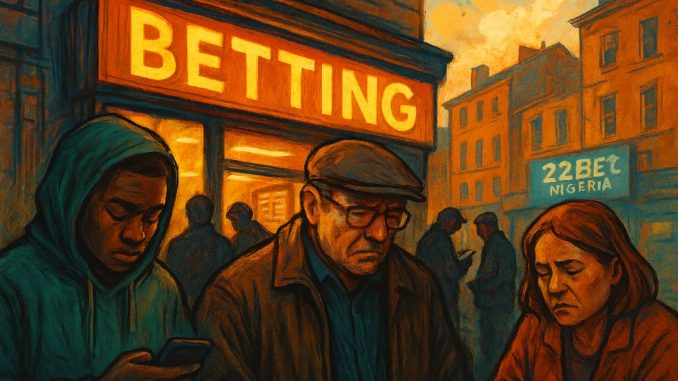
A Habit That Reflects the Times
People often talk about betting as if it were some side activity, a fringe habit sitting comfortably outside
the “real” issues of society. Yet the more you listen to people who gamble — really listen, without the
easy clichés — the more you realize it’s tied to the same pressures shaping everything else: rising costs,
unstable jobs, the quiet feeling that life keeps tightening while opportunities keep slipping away.
Betting isn’t an isolated pastime. It’s a symptom. A reaction. Sometimes even a quiet protest against a
world that gives little and demands much.
And that’s exactly why the radical-left perspective approaches gambling not with moral panic, but with a
simple question: What conditions push millions toward risk in the first place?
The Emotional Architecture Behind a Simple Bet
A small wager looks harmless enough. A quick slip written in pen, an on-screen tap after typing into
22Bet Nigeria, or a casual guess during a match between friends. But if you peel the gesture apart,
something more complicated appears.
Every bet contains a tiny spark of hope — not extravagant, not dramatic, just a flicker. In a world where
many people can’t predict next month’s finances, the idea that “maybe today turns out differently” holds
real emotional weight.
It’s not that people believe betting will solve everything. Most know the odds better than the companies
advertising at them. But the act itself — the moment where possibility opens, even briefly — can feel like
a relief from routines packed with uncertainty.
A System Built on Unsteady Ground
What’s striking is how naturally betting fits into modern economic life, almost as if the wider system were
designed to make risk feel normal. Work contracts are temporary. Prices jump unpredictably. Bills arrive
like waves. Savings become a luxury.
In such an environment, gambling doesn’t feel like an anomaly — it feels like an extension of the
instability people experience everywhere else. The risk is familiar. The waiting is familiar. The sense of
maybe tomorrow will be better is painfully familiar.
The radical-left critique points out something important here: instead of blaming people for placing bets,
we should examine why predictable, stable lives are now so rare that chance feels like a reasonable
companion.
Digital Platforms and the Disappearing Pause
Online betting introduces a different rhythm — smoother, faster, quieter. You log in, the screen lights up,
and the world contracts into numbers and colored icons. The noise of a physical betting shop
disappears; so does the social friction that helps people slow down.
Digital risk feels clean, almost weightless. The act of placing a bet becomes so easy that the
consequences feel distant. The design encourages continuous motion: one click, then another, then a
new set of odds.
The problem isn’t the digital format itself. It’s how deliberately these platforms remove every pause that
might let someone reconsider. Profit depends on speed — and speed depends on silence.
The Unequal Impact of the Same Loss
Two people might lose the same amount of money, yet the effect is entirely different. A middle-income
professional may forget the loss by dinner. A market vendor supporting a family might feel the absence
of that money for days.
And yet the industry markets uniformly, as if every player stands on the same floor, facing the same
winds. But they don’t. Betting companies rarely target affluent areas; their ads saturate working-class
neighborhoods, bus stations, online spaces where people already voice financial stress.
The uncomfortable truth:
- Betting draws the most revenue from those with the least cushion.
- The people most burdened by economic pressure face the strongest advertising.
- “Choice” is not the same for someone scraping by as it is for someone comfortable.
This imbalance isn’t incidental — it’s structural.
When Winning Is Sold as a Survival Strategy
One of the most insidious aspects of modern betting culture is the way it echoes the broader capitalist
myth that luck, hustle, or individual brilliance will eventually pay off. Work harder, try again, don’t quit —
this logic slips easily into gambling: maybe this bet, maybe this weekend, maybe this tiny miracle.
But relying on chance is not empowerment. It’s evidence that collective protections have eroded so
drastically that individuals must look for escape routes one ticket at a time.
People don’t gamble because they’re irrational. They gamble because the system itself has become a
form of gambling.
The Parts of Gambling That Still Feel Human
And yet — because people aren’t machines — gambling also contains moments of warmth. Friends
debating sports predictions with playful stubbornness. Relatives gathering for a small card game on a
quiet evening. Coworkers making silly bets on who arrives late next Monday.
These little rituals have nothing to do with profit and everything to do with connection. When stripped of
predatory systems, gambling becomes what it used to be: a social gesture, a storytelling device, a way
to pass time together.
These human forms of play survive despite the industry, not because of it.
A Leftist Path Forward
A radical-left analysis doesn’t demand a world without gambling. It demands a world where gambling
stops filling the gaps left by unequal structures. Where people don’t need a lucky break to pay rent.
Where betting becomes a harmless thrill, not a quiet lifeline.
In a fairer society:
- Wages would allow stable lives.
- Public services would reduce desperation.
- Companies couldn’t exploit emotional vulnerability.
- Gambling would shrink back to what it should be — a choice, not a coping strategy.
What Betting Reveals
Gambling exposes something many prefer not to confront: millions of people live with uncertainty so
constant that even a risky game feels like a breath of air.
The goal is not to shame the players. It’s to change the world that drives them to the edge of possibility
again and again. A just society doesn’t eliminate the thrill of chance — it simply ensures that no one
needs to rely on it to survive.
Leave a Reply