
A Familiar Thrill With Unfamiliar Roots
People like to treat gambling as if it belongs to a separate world — a sealed-off territory of glowing
screens, scratch cards, hushed casino corners, and noisy sports predictions shouted across crowded
bars. But anyone who’s bothered to look past the surface knows it never really sits apart from daily life. It
leaks into it, sometimes gently, sometimes like a flash flood.
A bet, after all, isn’t just a bet. It’s a tiny experiment conducted against the background noise of real
pressures: wages that wobble, rents that climb without shame, weeks that stretch thin. Someone places
five dollars on the outcome of a match, and underneath the gesture lies an entire architecture of
uncertainty. The gamble feels small, but the world that produced it — the one tightening around people
— is anything but.
The Soft Machinery That Pushes People Toward Risk
It’s easy to blame individual choices, but much harder — and far more honest — to notice the structural
nudges that drive people toward chance. Whether we’re talking about slipping into a local betting shop or
logging into a platform like 22Bet Uganda, the atmosphere around gambling is shaped less by personal
taste than by economic weather.
The radical-left argument here isn’t obscure: when the ground beneath people’s feet shifts constantly,
they start searching for places that offer even the illusion of agency. A spin, a number picked, a
prediction made — these tiny acts provide a sensation of motion, of possibility, even when everything
else feels immobilized by debts, by bills, by the dull grind of precarious work.
Of course, the industry recognizes this and refines the psychological machinery accordingly. The
prompts, the “limited-time odds,” the celebratory animations — all of it carefully calibrated to whisper,
“You’re in control,” while ensuring the house keeps its quiet, lopsided advantage.
Digital Gambling and the Vanishing Interruption
Digital platforms change something essential: they remove interruptions. In a casino, even a crowded
one, there are physical cues — noise, other people’s reactions, the simple fatigue of standing. Online,
the world collapses into a pocket-sized loop.
A gambler sits alone — sometimes tired, sometimes wired, occasionally both — and touches a screen.
Meanwhile the interface, sleek and patient, waits for the next gesture. There’s no bartender clearing a
glass, no friend asking a question, no walk home in the cold that might reset the mind. Just the screen,
the tap, the next possibility.
The strange part is that the solitude doesn’t always feel lonely. Sometimes it’s a relief to be unobserved.
But that privacy is the industry’s greatest advantage: it removes the frictions that ordinarily protect people
from themselves.
Inequality, Refracted Through Chance
The same bet carries wildly different meanings depending on who places it. A middle-class professional
might wager absent-mindedly, annoyed but unshaken by a loss. A single mother might gamble the same
amount and feel its absence in the week’s grocery planning. The mathematics may be identical, but the
consequences are not.
And this unevenness isn’t positioned at the margins — it’s the center of the issue:
- Gambling companies target neighborhoods with fewer resources.
- Advertising saturates communities already under economic strain.
- “Opportunity” is sold most aggressively to those with the least of it.
The industry, of course, denies this; profit rarely acknowledges the conditions that feed it. But the radical-
left perspective insists that gambling is not morally neutral — not when it feeds on structural
vulnerabilities instead of genuine risk-taking.
Hope, Packaged and Monetized
One of the most effective tricks of modern capitalism is the way it commodifies feelings — especially
hope. In everyday life, hope is slow and uncertain. In gambling, it becomes immediate, purchasable,
brightly lit.
People gamble because they want something to shift, even a little. They want the brief sensation of
standing at the edge of possibility instead of trudging through inevitability. These aren’t irrational desires.
They are deeply human responses to systems that deny many the dignity of stability.
But when hope becomes something you buy, even cheaply, it becomes something that can be taken
away — again and again, until the small losses blur into a soft, constant ache.
The Social Life Gambling Sometimes Recovers
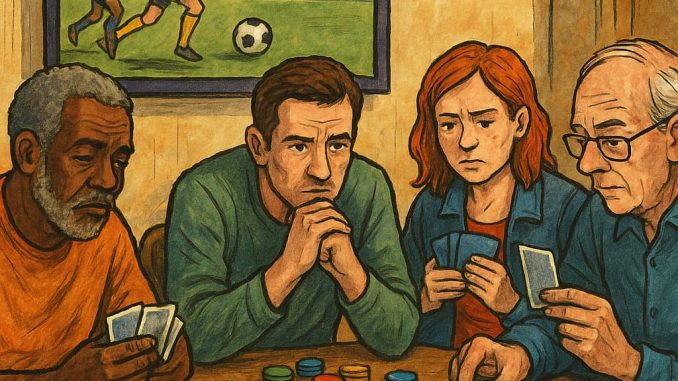
Despite all of this, gambling isn’t only predatory. It can be strangely communal. Friends predicting
outcomes together, groups teasing each other during matches, uncles teaching nieces how to play cards
with old, fraying decks — these are warm spaces, human spaces.
Left alone, gambling could remain a playful ritual of chances and jokes. But today, those communal
practices are overshadowed by commercial versions that extract value rather than nurture connection.
The industry doesn’t care about laughter. It cares about engagement metrics. And yet the old, communal
forms refuse to vanish — another reminder that people continuously try to reclaim joy from systems
determined to monetize it.
A Radical-Left Lens on What Needs to Change
A leftist analysis doesn’t say gambling should disappear. It says the world should stop manufacturing the
desperation that fuels its darker side. It asks, bluntly:
Why must people rely on luck to escape what collective action should fix?
Why is the possibility of a better life tied to a wager instead of to public policy?
Why does the state profit from bets while underfunding the very services that would reduce the need for
them?
A fair society wouldn’t eliminate the thrill of gambling; it would simply remove the conditions that make
the thrill feel necessary rather than optional.
What Gambling Quietly Tells Us
In the end, gambling reveals unsettling truths about the world:
that many people feel cornered,
that predictability has become a luxury,
that hope itself has been packaged and sold back to those who need it most.
And yet it also reveals something encouraging: people still reach for possibility, however small. They still
gather, still imagine, still create rituals of chance that defy the cold logic of profit.
The task, then, isn’t to extinguish the desire for risk. It’s to build a society where chance no longer
compensates for structural injustice — where a bet is merely a game, not a quiet cry for a life that feels
out of reach.
Leave a Reply